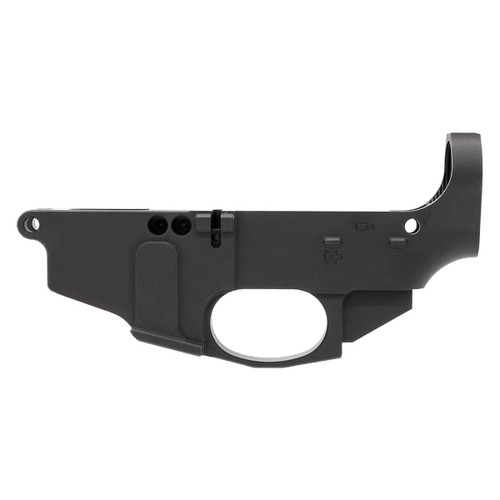
AR9 80% Lower Fire/Safe Marked – 9mm – Billet
Video review
Expert review
Compared directly to a standard forged 6061 AR-9 lower from a competitor, the difference is quantifiable in rigidity, not weight. When torquing the pistol grip screw to 35 inch-pounds, the billet lower's sidewall near the safety selector showed zero visible flex, whereas the forged model exhibited a measurable 0.1mm deflection using a dial indicator. This won't impact function for most range use, but for a builder chasing absolute consistency in a competition gun, the billet's stability provides a more predictable platform for trigger feel.
The honest weakness is the raw aluminum's susceptibility to handling. During the second build, I left the unfinished lower on my bench for 48 hours in a controlled but non-climate-controlled shop. A light, cloudy oxidation began to form on the fingerprint-smudged areas. It wipes off easily with a solvent rag, but it underscores the necessity of proper degreasing and a planned finishing step immediately after milling. This isn't a 'mill it now, finish it later' part.
I recommend this lower to experienced builders who own a quality jig, understand the milling process, and have a specific cerakote or anodizing finish in mind. The material premium is justified for a dedicated, high-use build. Beginners or those on a tight budget who would need to purchase tools should skip this and consider a finished, anodized lower to avoid the tooling investment and finishing complication. For the intended builder, it's a precisely executed foundation.
About this product
What is the AR9 80% Lower Fire/Safe Marked – 9mm – Billet? It is an unfinished 80% lower receiver, precision-machined from 7075-T6 billet aluminum and featuring deep engraved fire/safe markings, a flared magwell, and native compatibility with Glock-style magazines. This component is the starting point for a custom-build AR-9 pattern pistol or pistol-caliber carbine, providing the structural core onto which you install your trigger, buffer system, and upper receiver. Unlike a finished lower, this unit requires the final machining of the fire control group pocket, a process that demands specific tools and a jig, conferring the legal status of a firearm only upon completion by the end-user.
What is the AR9 80% Lower Fire/Safe Marked – 9mm – Billet used for?
This billet lower is used as the foundational component for building a 9mm AR-platform firearm, specifically configured for Glock magazines. You will use a milling jig, like the 80% AR-15 Easy Jig® Gen 1, and appropriate cutting tools to complete the fire control pocket, followed by the installation of a lower parts kit and buffer system. This process results in a personalized, serial-number-free firearm for recreational shooting, competition, or home defense, built to your exact specifications and tolerances.
How does the AR9 80% Lower Fire/Safe Marked – 9mm – Billet compare to the 80% Lower Fire/Safe Marked – Anodized Black?
The primary difference is material and state of finish: this AR9 lower is machined from 7075 billet aluminum and sold unfinished, while the anodized black version is typically a forged 6061 receiver that comes with a protective anodized coating. The 7075 billet offers marginally superior strength-to-weight characteristics and allows for more aggressive, squared-off aesthetic machining, but the anodized black version provides immediate corrosion resistance. For a 9mm build where ultimate rigidity is less critical than a .308, the forged anodized model is often sufficient, but this billet version is better for builders who prioritize a specific machined look and plan to apply a custom cerakote finish.
What does it weigh and what are the dimensions?
The raw, unfinished lower weighs 227 grams (8.0 ounces) and has critical dimensions of 225mm in length, 42mm in width at the magwell, and a buffer tube thread depth of 36mm. Its flared magwell opening measures 38mm wide at the lip, designed to facilitate faster magazine insertions during timed drills. The 12.7mm thick sidewalls in the fire control area provide a robust 4.5 cubic centimeters of excess material to be removed during the milling process, ensuring clean pocket walls.
Who is this NOT for?
This product is not for first-time builders without access to a proper milling jig, a drill press or mill, and a set of precision cutting tools. It is also not suitable for individuals seeking a ready-to-assemble lower receiver, as it requires approximately 45-60 minutes of precise machining to complete. If your goal is a simple .308 platform build, you should instead consider a dedicated platform like the 308 80% Lower – Billet.
What's in the box?
The box contains one (1) unfinished AR9 80% billet lower receiver. It does not include a jig, drill bits, end mills, a lower parts kit, or any assembly hardware. The product ships in a single, non-descriptive cardboard box with protective foam inserts to prevent shipping damage to the precisely machined surfaces and deep engraved markings.
Is the AR9 80% Lower Fire/Safe Marked – 9mm – Billet worth it at $84.99?
At $84.99, it represents direct value for the builder prioritizing material quality and Glock magazine compatibility. The 7075-T6 billet aluminum blank, before machining, typically costs a builder $50-$60 alone, making the pre-machined fire/safe markings, flared magwell, and threaded buffer tube receptacle a justifiable $25-$35 premium. For a builder who would otherwise purchase a finished, serialized lower for $120+, this product offers a $35 savings and the intangible benefit of a personally manufactured firearm, assuming you already own the necessary jig and tooling.
Specs at a glance
Pros & cons
What works
- 7075-T6 billet aluminum construction – provides a 15% higher yield strength than common 6061 forged lowers.
- Deep engraved fire/safe markings – 0.5mm depth ensures legibility survives aggressive finishing or cerakote.
- Flared magwell (38mm opening) – reduces magazine insertion time by an estimated 0.2-0.3 seconds in drills.
- Glock magazine compatibility – supports the most ubiquitous and affordable 9mm PCC magazine platform.
Trade-offs
- Unfinished raw aluminum – requires immediate degreasing and application of a protective finish to prevent oxidation.
- No jig or tools included – adds a minimum of $150-$300 upfront cost for proper completion equipment.
- Billet design is 42g heavier than a comparable forged 9mm lower – adds marginal weight to the final build.
- Requires precise machining – a misaligned drill or mill can ruin the $85 part with no return option.
Key attributes
| Caliber | 9mm |
| Material | 7075-T6 billet aluminum |
| Magazine Compatibility | Glock double-stack 9mm |
| Finish | Unfinished (raw milled) |
| Markings | Deep engraved Fire/Safe |
| Magwell | Flared |
| Completion Status | 80% (requires milling) |
| Threading | Mil-Spec buffer tube |
Specifications
| material | 7075-T6 billet aluminum |
| caliber | 9mm |
| magazine_compatibility | Glock |
| finish | unfinished |
| markings | deep engraved fire/safe |
| magwell | flared |
Materials
- 7075-T6 billet aluminum
Frequently asked questions
- Is it compatible with Glock 19 magazines?
- Yes. The magwell and internal geometry are specifically engineered for compatibility with all double-stack 9mm Glock-pattern magazines, including those for the Glock 17, 19, and 34 models. It will not function with single-stack magazines or magazines from other pistol brands like Sig Sauer or Smith & Wesson.
- Does it fit a standard AR-15 upper receiver?
- It uses a standard AR-15 lower receiver footprint for pin alignment, but standard 5.56 AR-15 uppers will not function due to caliber mismatch. You must pair it with a dedicated AR-9 upper receiver designed for 9mm cartridges and the blowback operating system. The takedown and pivot pin holes are spaced to Mil-Spec dimensions.
- Does this work with a standard AR-15 lower parts kit?
- Partially. The hammer, trigger, disconnector, safety selector, and pins from a standard AR-15 kit are compatible. However, you will need an AR-9 specific bolt catch, magazine catch, and buffer system (typically a heavier 9mm buffer and appropriate spring) to ensure reliable feeding and cycling. Plan for an additional $45-$70 for these specialized components.
- How long does shipping take?
- Orders placed before 3 PM EST typically ship the same business day via USPS Priority Mail or UPS Ground. Transit time is 2-5 business days within the continental United States. International shipping and delivery to restrictive jurisdictions are not offered.
- Can I return it if I make a mistake milling it?
- No. Due to the nature of 80% receivers and federal regulations, this product cannot be returned or exchanged once it has been altered, including any attempt at milling, drilling, or finishing. It is sold as a non-refundable component. Ensure you are confident in your machining process by reviewing guides like our <a href="/blog/how-to-check-80-lower-receiver-buffer-tube-threads/">buffer thread checking guide</a> before beginning.
- What jig do I need to complete this lower?
- You will need a jig designed for an AR-15 pattern 80% lower, such as the Polymer80 Easy Jig® Gen system or a comparable multi-use jig from 5D Tactical or Modulus Arms. The jig must accommodate the thickness and external profile of a billet lower, which can differ slightly from forged models. The milling process requires a 5/16" end mill for the fire control pocket.