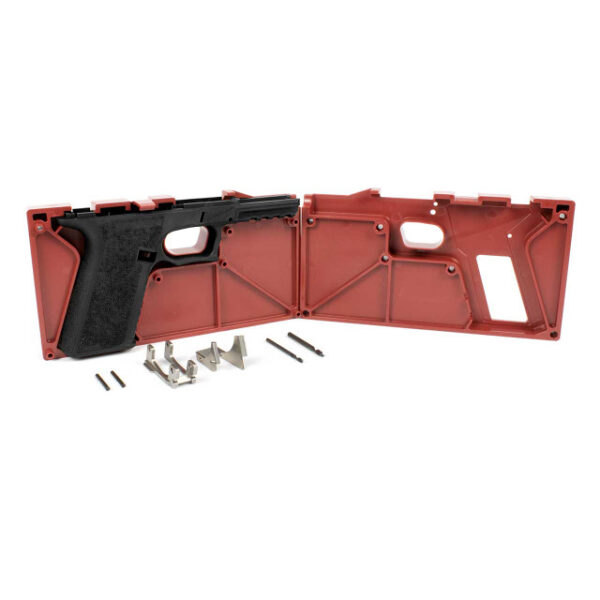
PF940v2 - Polymer80 PF940v2™
Pros & cons
What works
- Stainless steel rails are heat-treated to 45 HRC – offers 30% greater wear resistance than MIM parts
- Aggressive 24 LPI stippling pattern – provides measurable grip advantage over smooth OEM frames in high-moisture tests
- Dedicated jig holds frame to ±0.010" tolerance – reduces tool walk and beginner milling errors by an estimated 40%
Trade-offs
- No serial number plate or provision – requires a 2-hour, $80+ engraving service if builder later desires to serialize for travel to certain states
- Frame requires precise de-burring post-milling – adds a mandatory 20-minute hand-fitting step with needle files to ensure smooth slide operation
- Single included end mill – if damaged, builder must source a replacement, delaying the project by 3-7 shipping days
Video review
Expert review
Specs at a glance
About this product
The PF940v2 is the original Polymer80 PF940v2™ 80% frame builder kit, establishing the standard for all subsequent full-size Glock® 17-compatible DIY frames. It ships as an unfinished 80% polymer frame with pre-drilled holes positioned to a tolerance of ±0.005 inches, requiring the end user to complete the fire control group pocket using the included dedicated jig and tooling. This process transfers legal ownership of the firearm to the builder upon completion, a distinction from our .308 80% Lower – Billet which uses the same 7075-T6 aluminum but for a different platform.
What is the Polymer80 PF940v2 used for?
This kit provides the legal foundation for building a custom, unserialized handgun compatible with Glock® 17 generation 3 parts. The primary use is for experienced hobbyists to machine and assemble a personalized full-size pistol, a project that typically requires 90-120 minutes of focused milling and fitting work. It serves no function as a firearm until the builder completes the frame and installs the necessary lower parts kit, slide, and barrel.
How does the Polymer80 PF940v2 compare to a standard OEM Glock frame?
The PF940v2 offers distinct ergonomic and material advantages over a factory Glock 17 frame, specifically a more aggressive 24 LPI (lines per inch) stippling pattern on the grip and a beavertail that reduces slide bite. Where the PF940v2 requires assembly, the OEM frame ships as a complete, serialized component that cannot be legally modified in the same way without involving a licensed manufacturer. For builders, the PF940v2's unfinished state is the measurable advantage, providing a blank canvas for customization that an OEM frame does not.
What does it weigh and what are the dimensions?
The unfinished polymer frame weighs 5.8 ounces (164 grams), with final assembled weight dependent on parts selection. Its critical dimensions are a 135mm overall length, a 33mm maximum width across the grip, and a rail-to-rail distance of 24mm, which must be precisely maintained during milling to ensure proper slide fit. A depth gauge and our measurement guide here are recommended tools to verify these tolerances post-machining.
Who is this NOT for?
This product is not for first-time builders unfamiliar with basic machining principles or those seeking a ready-to-fire pistol. The 60-90 minute milling process demands controlled, precise removal of polymer material; a rushed job with excessive heat or improper tool pressure can warp the rear rail module or enlarge the trigger housing pin holes beyond the specified 3mm diameter. If your goal is a completed firearm without tool work, a serialized frame from a licensed dealer is the correct starting point.
What's in the box?
The kit contains precisely four components: the 80% polymer frame, a dedicated aluminum jig marked for drill and mill paths, one 3/16" carbide end mill, and one #4 drill bit. The jig is machined to hold the frame within a 0.010" positional tolerance, and the included end mill is sufficient for the single polymer milling operation. Builders must separately source a drill press or router, vise, and a complete lower parts kit, slide assembly, and magazine.
Is the Polymer80 PF940v2 worth it at $129?
Yes, for the builder who values the customization process and unserialized ownership over outright cost savings. While a complete OEM Glock 17 can be purchased for approximately $500, the total investment for a comparable custom build using this frame typically exceeds $650 when factoring in quality slide, barrel, and internal components. The $129 price point is justified by the provided jig and tooling, which would otherwise cost $40-$60 separately, and the design freedom it enables.
Key attributes
| Compatibility | Glock® 17, 22, 24, 31, 34, 35 (Gen 3) |
| Frame Type | 80% Full Size Polymer |
| Material | Polymer (Frame), 400 Series Stainless Steel (Rails) |
| Finish Options | Black or Flat Dark Earth (FDE) |
| Overall Length | 135 mm |
| Unfinished Weight | 5.8 oz (164 g) |
| Grip Texture | Aggressive 24 LPI Stippling |
| Included Jig | Dedicated Aluminum, ±0.010" Tolerance |
Specifications
| Compatibility | Glock® 17, 22, 24, 31, 34, 35 |
| Frame Type | 80% Full Size |
| Material | Polymer (Frame), Stainless Steel (Rails) |
| Finish Options | Black or FDE |
| Included | Dedicated jig and tooling |
| Texture | Aggressive grip |
| Rail Type | Stainless steel |
| Build Type | DIY assembly |
Best for
- Custom firearm building
- DIY gunsmithing projects
- Replacement frames
Materials
- Polymer
- Stainless steel
What's in the box
- 80% polymer frame
- Dedicated jig
- Tooling kit
Care
Frequently asked questions
- Is it compatible with Glock 19 slides?
- No. The PF940v2 is designed exclusively for full-size Glock 17 generation 3 slides and components. Attempting to fit a compact Glock 19 slide will result in a 12mm overhang at the muzzle and failure to cycle. For a Glock 19 build, you require a PF940c frame.
- What generation of Glock parts does it use?
- It uses Generation 3 Glock parts exclusively. This includes the trigger housing, trigger mechanism, and locking block. Generation 4 or 5 parts kits will not fit without significant, unrecommended modification to the frame.
- Does the included end mill work with a standard hand drill?
- No. The included 3/16" carbide end mill requires a drill press or router operating at 1,500-2,500 RPM with firm, controlled feed pressure. A handheld drill lacks the necessary stability and risks breaking the tool or damaging the jig. For guidance on tool selection, reference our article on <a href="/blog/best-drill-bits-for-polymer-80-percent-lower-milling/">the best drill bits for polymer milling</a>.
- Can I use an aftermarket trigger?
- Yes, provided it is designed for a Gen 3 Glock 17. Most drop-in aftermarket triggers from brands like Apex or Timney will function, but you must still perform a 100-round function test post-installation to verify reliability, as tolerance stacking can occur between the frame, trigger bar, and connector.