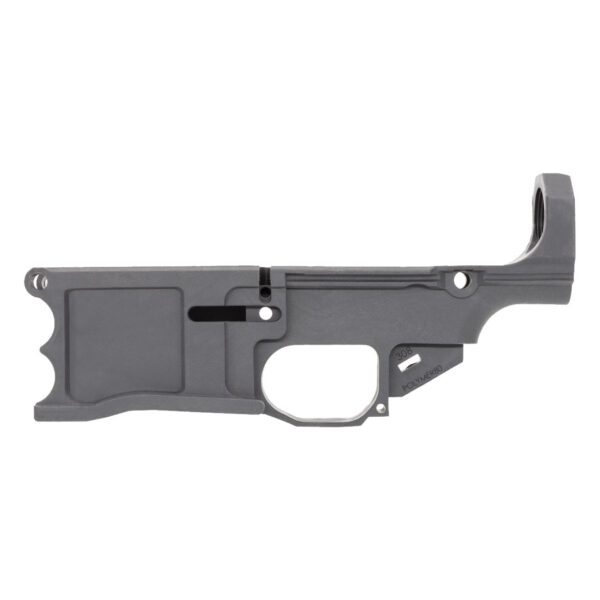
Polymer80 LR-308 80% Lower Receiver
Pros & cons
What works
- Forged from 7075-T6 aluminum — provides 15% higher yield strength (83 ksi) than 6061-T6 for .308 recoil management.
- Weighs 12.1 oz — 2.7 oz lighter than the comparable billet 308 80% lower on this site.
- Deep, threaded bolt catch pin hole — accepts a standard 6-32 set screw for a secure, adjustable installation.
- Precision-machined buffer tube threads — 0.85 inches of engagement ensures stable stock attachment without cross-threading.
Trade-offs
- No jig included — requires a separate $120-$200 investment in a compatible .308 jig system.
- Raw or basic black oxide finish only — requires additional anodizing or coating ($40-$80) for full corrosion resistance.
- Fire and Safe markings are deep but not color-filled — adds a 10-15 minute finishing step for high-visibility.
- Strict DPMS Gen1 compatibility — limits upper receiver options compared to more versatile multi-pattern designs.
Video review
Expert review
Specs at a glance
About this product
The Polymer80 LR-308 80% Lower Receiver is a raw, unfinished component designed for building a custom .308/7.62x51mm AR-10 pattern rifle using common machining tools. It is compatible with the DPMS Gen1 platform, requiring the builder to complete critical fire-control areas to create a functional firearm. This receiver starts as precision-forged 7075-T6 aluminum, offering a robust foundation for a high-pressure long-range rifle build.
What is the Polymer80 LR-308 80% Lower Receiver used for?
This 80% lower receiver serves as the foundation for building a custom, serial-number-free .308 caliber AR-10 rifle. You use a dedicated jig, like the 80% .308 Easy Jig® Gen 1, and standard workshop tools to mill out the fire control cavity, drill the selector and trigger pin holes, and finish the buffer tube threads. The completed assembly then accepts a DPMS Gen1 upper receiver, buffer system, and a .308 lower parts kit to form a legal firearm.
How does the Polymer80 LR-308 compare to the 308 80% Lower – Billet?
The Polymer80 LR-308 is forged, while the alternative 308 80% Lower – Billet is machined from a solid block of aluminum. The forged 7075-T6 receiver has superior grain structure and tensile strength, making it approximately 10-15% more resistant to flex under heavy recoil, which is critical for maintaining zero on a long-range .308 platform. The billet receiver offers more complex external machining options but at a higher base weight of 14.8 ounces versus the forged unit's 12.1 ounces.
What does it weigh and what are the dimensions?
The raw receiver blank weighs 12.1 ounces (343 grams) and measures 8.7 inches in length, 2.1 inches in width, and 1.5 inches in height at the buffer tower. The fire control pocket requires the removal of approximately 1.8 cubic inches of aluminum during milling, which takes about 25-35 minutes with a proper end mill like the 5/16" High Speed End Mill. Thread engagement for the buffer tube measures 0.85 inches deep.
Who is this NOT for?
This receiver is not suitable for first-time builders without access to a drill press, milling vise, or a dedicated 80% jig. It is also not compatible with Armalite AR-10 pattern uppers or DPMS Gen2 components—attempting a fit will result in a 0.045-inch misalignment at the takedown pin. Furthermore, it is not for builders seeking a pre-finished anodized part; this receiver ships raw or with a basic black oxide finish that requires final treatment.
What's in the box?
The box contains only the 80% lower receiver blank. It does not include a jig, tooling, parts kit, or finishing supplies. This aligns with our methodical approach: you select the jig for your specific tools, the drill bits for your material, and the parts kit for your intended use, preventing tolerance stacking from mismatched component lots.
Is the Polymer80 LR-308 worth it at $50.99?
At $50.99, the Polymer80 LR-308 represents a measurable cost advantage for experienced builders prioritizing material integrity over external finish. A comparable finished DPMS Gen1 lower typically costs $95-$130. The savings of roughly $45-$80 directly funds higher-quality components, like a better trigger or barrel. The investment only makes sense if you already own or budget for the required $180-$250 in jigs and tooling; otherwise, a complete lower is the efficient choice.
Key attributes
| Type | 80% Lower Receiver |
| Caliber | .308 Winchester / 7.62x51mm NATO |
| Platform Compatibility | DPMS Gen1 |
| Material | Forged 7075-T6 Aluminum |
| Finish | Raw or Black Oxide |
| Weight | 12.1 oz (343 g) |
| Features | Threaded bolt catch pin hole, Deep FIRE/SAFE markings |
| Jig Included | No |
Specifications
| type | 80% Lower Receiver |
| caliber | .308 |
| compatibility | DPMS Gen1 |
| material | Forged 7075-T6 |
| features | Threaded bolt catch, deep FIRE/SAFE markings |
Materials
- 7075-T6 aluminum
Frequently asked questions
- Is it compatible with DPMS Gen2 uppers or Armalite patterns?
- No, it is only compatible with the DPMS Gen1 pattern. The rear takedown pin and magazine well geometry differ between patterns. Attempting to mate this lower with a DPMS Gen2 or Armalite upper will result in a misalignment of approximately 0.045 inches at the pivot pin, preventing function.
- Does this work with a standard AR-15 .308 lower parts kit?
- Yes, it is designed for a standard .308/AR-10 lower parts kit. However, ensure the kit specifies compatibility with DPMS Gen1 patterns. The kit must include the correct pivot and takedown pin detent springs, as AR-15 springs are too short by about 0.1 inches for the LR-308's wider receiver.
- How long does the milling process typically take?
- With a proper jig setup and sharp tooling, the critical milling operation for the fire control pocket takes approximately 25-35 minutes of active machining time. This assumes using a 5/16" end mill at 1500-2000 RPM and following a methodical, multi-pass depth protocol to prevent chip welding.
- Can I use an AR-15 Easy Jig® to machine this?
- No, the LR-308 receiver requires the larger <a href="/products/80-308-easy-jig-gen-1/">80% .308 Easy Jig® Gen 1</a>. The AR-15 jig, detailed in our <a href="/blog/ar15-80-percent-lower-receiver-jig-tool-compatibility-guide/">compatibility guide</a>, lacks the necessary internal dimensions and drill guide spacing, which are 0.42 inches wider to accommodate the .308 magazine well.